
Ask Money Questions. Get Real Answers for Nigeria. Grow Your Wealth Smarter.
Learn about investing, business, and financial growth in a simple way. Get answers from real people and experts across Africa.
Ask A QuestionLatest Finance News on Fokona
Fokona Latest Articles

Hello World!
My name is Mbadiwe Ikechukwu, popularly known as Iking Ferry.And today…I am not just writing a blog post.I am documenting the beginning of a mission. Let me say something very simple…But very powerful.Most people are not poor because they are ...

Why Zenith Bank Share Price Dropped After Dividend Declaration – Technical Adjustment Explained
Most Nigerians lose money in the stock market not because they invested in bad companies… But because they do not understand how the market actually works. One of the biggest areas where beginners get confused is something called: “Technical Adjustment.” ...
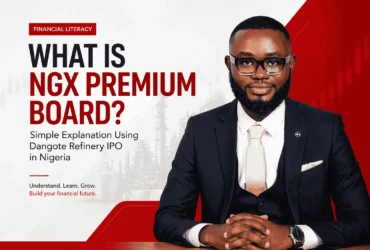
What is NGX Premium Board? (Explained Simply Using Dangote Refinery IPO in Nigeria)
Last week, I asked a simple question: “If Dangote Refinery IPO is listed on the Premium Board… do you understand what that means?” Many people said: “Iking, please explain.” So today…. As your Financial Literacy Advocate, let me break it ...
Joint ownership of shares/stocks.Can Two or More People Jointly Own Shares in Nigerian Stock Market (NGX) Without Forming a Company?
Yes — it is possible in Nigeria for two or more people to jointly own shares on the NGX without forming a company, but there are important technical and practical limitations you must understand. Let’s break it down properly. 1. The Core Answer ✔ Yes, joint ownership of shares is allowed in NigeriaRead more
Yes — it is possible in Nigeria for two or more people to jointly own shares on the NGX without forming a company, but there are important technical and practical limitations you must understand.
See lessLet’s break it down properly.
1. The Core Answer
✔ Yes, joint ownership of shares is allowed in Nigeria (NGX system supports it)
❌ But it is NOT as flexible as a bank joint account
⚠️ It is usually structured as “Joint Shareholders Account” through a stockbroker
So legally:
Two or more individuals can be registered as joint holders of the same securities
But it must be done through a brokerage account setup, not directly at NGX
2. How Joint Share Ownership Works in Nigeria
When you open a stockbroking account, you can choose:
A. Individual account
One name
One BVN
One signature authority
B. Joint account (what you’re asking about)
Two or more people listed as co-owners
Usually structured as:
“A and B Joint Account”
or “A OR B” / “A AND B”
3. Types of Joint Ownership Structures
1. “AND” Joint Account (Strict control)
Both parties MUST approve transactions
Strongest control structure
Less flexible
2. “OR” Joint Account (Flexible control)
Either party can act independently
Easier for trading
3. “Survivor” clause (important in inheritance)
If one dies, ownership transfers to the surviving holder(s)
4. What is Required to Set It Up
To open a joint stock account in Nigeria, you typically need:
Valid ID for all parties (NIN, passport, etc.)
BVN for each individual
Passport photographs
Joint account opening form from stockbroker
Bank account (sometimes joint or designated settlement account)
Next of kin details
You open it through a licensed stockbroker, not NGX directly.
5. Important Limitations (Most people miss this)
❌ You cannot bypass brokerage structure
You cannot just “co-own shares informally” like land or crypto wallets.
❌ Each transaction still passes through a broker
Even if jointly owned, NGX does not allow direct retail access.
❌ Dispute risk exists
If relationship breaks down:
selling shares requires compliance with account mandate
broker follows signed instructions, not verbal agreements
6. Practical Reality in Nigeria
Joint stock ownership is:
✔ legally possible
✔ administratively supported
⚠️ not commonly used in retail investing
Why? Most Nigerians prefer:
individual accounts for control simplicity
or informal trust arrangements (which are riskier)
7. When Joint Stock Ownership Makes Sense
It works best when:
Family investment pool (parents + children)
Business partners pooling capital
Estate planning (wealth transfer structure)
Long-term investment trust setup
8. When It is NOT a Good Idea
Avoid joint accounts if:
relationship trust is not strong
you want independent trading freedom
you expect frequent buying/selling disagreements
9. Better Alternative (Often Recommended)
Instead of joint ownership, many professionals use:
Option A: One person holds, others document agreement
Cleaner execution
Lower brokerage friction
Option B: Create a simple investment club structure
informal partnership agreement
each contributes capital
one broker account manager executes trades
Option C: Formal investment vehicle (advanced)
cooperative or limited company (for large capital pools)
10. Final Conclusion
✔ Yes, joint ownership of NGX shares is possible in Nigeria
✔ It is done through brokerage “joint accounts,” not directly at NGX
⚠️ It is legally valid but operationally more rigid than bank joint accounts
✔ Best used for family or structured investment groups, not casual arrangements
Which Is a Better Investment for Beginners in Nigeria: Land Banking in Rural Areas or the Stock Market?
This is a strong question because you’re comparing two completely different asset classes: one is real estate speculation (land banking) and the other is financial market investing (stocks). The “best” depends on risk tolerance, liquidity needs, and time horizon—but I’ll break it down clearly for soRead more
This is a strong question because you’re comparing two completely different asset classes: one is real estate speculation (land banking) and the other is financial market investing (stocks). The “best” depends on risk tolerance, liquidity needs, and time horizon—but I’ll break it down clearly for someone earning ₦500k/month in Nigeria.
See less1. Quick Verdict (Straight Answer)
For a beginner in Nigeria:
Stock market (especially mutual funds / ETFs) is the better starting point than rural land banking.
But the optimal long-term strategy is actually:
Stocks first → then real estate later for diversification
2. Side-by-Side Comparison
A. Land Banking in Rural Areas (Nigeria)
What it is
Buying cheap land in developing areas and holding it for appreciation.
Pros
High upside if location eventually develops
Physical asset (feels “safe”)
Can multiply value in 5–15 years
Cons (very important in Nigeria)
❌ High fraud risk (Omonile issues, double allocation, fake titles)
❌ Low liquidity (you can’t quickly sell)
❌ No passive income while holding
❌ Requires deep local knowledge + legal checks
❌ Development is unpredictable (some areas never grow)
Reality
Many beginners:
buy “cheap land” that becomes a legal or illiquid trap
B. Stock Market (Nigeria: equities + mutual funds)
What it is
Buying shares in companies (GTCO, MTN, Dangote Cement) or pooled funds (money market, equity funds).
Pros
✅ Highly liquid (you can sell in days)
✅ Low entry barrier (₦5k–₦50k can start)
✅ Diversified risk (mutual funds reduce mistakes)
✅ Passive income (dividends + interest)
✅ Transparent pricing
Cons
Market volatility (prices fluctuate)
Emotional discipline required
Requires basic financial understanding
Reality
If structured properly (mutual funds first):
It is the safest entry point into investing in Nigeria
3. Risk Reality in Nigeria (Very Important)
Risk Type
Land Banking
Stock Market
Fraud risk
🔴 High
🟡 Medium
Liquidity risk
🔴 Very high
🟢 Low
Volatility
🟢 Low
🟡 Medium
Knowledge requirement
🔴 High
🟡 Medium
Accessibility
🔴 Difficult
🟢 Easy
4. For Someone Earning ₦500k/month (Best Strategy)
You are in a strong income bracket for Nigeria. The mistake many people make is:
putting too much into illiquid assets too early
A smarter structure:
Step 1: Build Financial Base (first 6–12 months)
Emergency fund (3–6 months expenses)
Money market mutual funds (stable yield)
Step 2: Enter Stock Market (core investing engine)
40–60% of investable funds
Start with:
Money market funds (low risk)
Then equity funds (moderate risk)
Then individual stocks (advanced)
Step 3: Add Land Banking later (not early stage)
Only when:
you understand land titles
you can verify property legitimacy
you already have liquid investments
5. Key Insight Most Beginners Miss
Land banking feels safer because it is physical.
But in Nigeria reality:
“physical does not mean secure”
Stocks feel risky because they fluctuate.
But in reality:
regulated financial markets + liquidity = lower practical risk for beginners
6. Final Recommendation
For you specifically (₦500k/month income, beginner investor):
Best path:
Start with stock market via mutual funds (70%)
Build emergency + liquidity buffer (20–30%)
Delay land banking until you are experienced (6–24 months later)
7. Simple Bottom Line
Best for beginners: ✔ Stock market (mutual funds first)
Best for wealth building over time: ✔ Combination of stocks + real estate
Worst mistake: ❌ rushing into rural land banking without experience
Can I Invest in Nigerian Money Market Funds (MMF) From Togo Without a Nigerian Bank Account?
Short answer: you cannot directly invest in Nigerian Money Market Mutual Funds (MMMFs) from Togo without some form of Nigerian financial access (bank account or approved fintech/investment onboarding). But there are structured workarounds. Let’s break it down clearly. 1. Why Nigerian MMMFs are hardRead more
Short answer: you cannot directly invest in Nigerian Money Market Mutual Funds (MMMFs) from Togo without some form of Nigerian financial access (bank account or approved fintech/investment onboarding). But there are structured workarounds.
See lessLet’s break it down clearly.
1. Why Nigerian MMMFs are hard to access from Togo
Nigerian Money Market Mutual Funds (like those from Stanbic IBTC, ARM, Vetiva, FCMB, etc.) are:
SEC Nigeria–regulated unit trusts
Naira-denominated investments
Designed mainly for:
Nigerian residents
People with Nigerian bank accounts + BVN/NIN
Even when some funds allow diaspora investors, they still require:
identity verification (BVN or passport + Nigerian KYC system)
a Nigerian settlement account for payouts
So from Togo with no Nigerian bank account, you are outside the normal onboarding rails.
2. The core restriction (important)
To invest in Nigerian MMMFs you typically need at least one of these:
A. Nigerian bank account (most common requirement)
Used for:
funding subscription
receiving redemption (withdrawals)
dividend/interest payouts
B. Nigerian brokerage / asset manager onboarding
Some fund managers allow:
diaspora accounts
but still require Nigerian-linked verification and banking rails
Without either → you cannot directly subscribe.
3. Your realistic options from Togo
Option 1: Open a Nigerian bank account remotely (best route)
Some Nigerian banks allow diaspora onboarding:
GTBank
Zenith Bank
Access Bank (limited cases)
You may need:
International passport
Proof of address in Togo
Possibly NIN/BVN (or biometric onboarding later)
Once you have that:
you can invest in MMMFs like normal Nigerians
e.g. Stanbic IBTC Money Market Fund, ARM Money Market Fund
Option 2: Use Nigerian fintech/investment platforms (if they accept diaspora)
Some platforms (varies by compliance rules) may allow signup with:
international phone number
passport verification
Examples of ecosystem types:
mutual fund aggregators (Cowrywise-type platforms)
asset manager portals
But limitation remains:
Funding and withdrawals usually still require Nigerian bank rails
So this often still loops back to Option 1.
Option 3: Invest in USD money market funds instead (practical alternative)
If your goal is money market yield + safety, but you are outside Nigeria:
You may find it easier to access:
USD money market funds
global brokerage cash sweep funds
African cross-border investment platforms
These avoid:
Naira restriction
Nigerian banking dependency
Option 4: Indirect exposure via a Nigerian contact (not ideal)
Some people use:
trusted relative/friend in Nigeria
who invests on their behalf
But this introduces:
legal ownership risk
trust risk
loss of control over funds
Not recommended unless highly structured legally.
4. Key reality check (important)
Even though MMMFs are “simple investments,” in Nigeria they are still:
domestically regulated financial products
tied to local banking infrastructure
So “from Togo without Nigerian bank account” is basically:
❌ Not directly accessible
✔️ Only accessible after creating Nigerian financial identity/rail
5. Best path for you (clean strategy)
If I were structuring this for you:
Open Nigerian bank account (diaspora onboarding if possible)
Get BVN/NIN if required
Fund account via international transfer
Then invest in:
Money Market Funds (stable cash yield)
Treasury bills (optional upgrade)
If you want, I can map out:
the exact easiest Nigerian bank for diaspora onboarding
or a step-by-step setup plan from Togo → investing in MMMF in under 2–4 weeks
Does learning Stock Investing as a Digital Marketer in Nigeria count as pursuing something outside my expertise?
No—learning stock investing as a digital marketer is not automatically “pursuing something outside your expertise” in a harmful way. In fact, it can be a smart expansion of your financial skillset if done correctly. Let’s separate the idea into two parts so it becomes clear. 1. What that “fastest waRead more
No—learning stock investing as a digital marketer is not automatically “pursuing something outside your expertise” in a harmful way. In fact, it can be a smart expansion of your financial skillset if done correctly.
See lessLet’s separate the idea into two parts so it becomes clear.
1. What that “fastest way to be poor” statement really means
When people say something like:
“The fastest way to be poor is pursuing what you can’t do”
They are usually referring to blind action without competence, not learning new skills.
It typically means:
Jumping into trading without understanding risk
Investing based on hype or emotion
Putting large money into things you don’t understand
Copying others without personal analysis
So the real warning is about:
acting without skill, not learning outside your field
2. Does stock investing fall outside a digital marketer’s expertise?
Not really.
As a digital marketer in Nigeria, you already have transferable advantages:
You already understand:
Data and trends (important in market behavior)
Consumer behavior (useful in equity analysis of companies)
Risk vs ROI thinking (marketing budgets already require this logic)
Online tools and platforms (brokers, apps, research tools)
So investing is not “foreign territory”—it is:
a different financial application of analytical thinking
3. The real distinction you should care about
There are 3 levels here:
❌ Level 1: Dangerous (ignorance + money)
“I heard this stock will pump”
No research
Emotional buying
⚠️ Level 2: Learning phase (where you are now)
Studying stocks
Starting small investments
Making beginner mistakes but learning
✅ Level 3: Competent investor
Understands valuation, risk, cycles
Has strategy (long-term, dividend, growth, etc.)
Doesn’t rely on luck or hype
You are clearly in Level 2, which is normal and necessary.
4. The correct mindset: “Core skill + financial skill”
You are:
Core skill: Digital marketing (income generation)
New skill: Investing (wealth preservation + growth)
This is actually a strong combination.
Why? Because:
Marketing gives you income
Investing protects and multiplies it
This is how wealth is usually built:
Earn → Allocate → Grow → Reinvest
5. The real risk is not “outside expertise”
The real risks are:
Overconfidence after small gains
Treating stock market like gambling
Spreading money without structure (you mentioned this issue before)
Not having a risk plan
Those are the dangers—not the learning itself.
6. Practical guidance for you (important)
Since you are a beginner investor:
Start with this structure:
60–70%: stable instruments (money market / fixed income funds)
20–30%: stocks (learning + long-term growth)
Keep position sizes small per stock
And:
Focus on 3–5 companies, not many
Think in years, not weeks
Avoid emotional trading
Bottom line
Learning stock investing as a digital marketer is:
❌ not a mistake
❌ not “outside your expertise” in a negative sense
✅ actually a strategic financial upgrade
The real danger is not learning something new—it’s acting in markets without structure or discipline.
How do GTCO mutual funds works?
Guaranty Trust Holding Company Plc mutual funds are professionally managed investment pools run by their asset management arm, typically GTCO Asset Management. Instead of buying individual stocks or bonds yourself, you contribute money into a fund, and experts invest it on your behalf. Here’s how itRead more
Guaranty Trust Holding Company Plc mutual funds are professionally managed investment pools run by their asset management arm, typically GTCO Asset Management. Instead of buying individual stocks or bonds yourself, you contribute money into a fund, and experts invest it on your behalf.
See lessHere’s how it works in practical terms (especially in Nigeria):
1. You Buy “Units,” Not Shares
When you invest, your money is converted into units of the fund.
Each unit has a price called Net Asset Value (NAV)
Example:
If NAV = ₦10 and you invest ₦50,000 → you get 5,000 units
As the fund performs, the NAV rises or falls
2. The Fund Invests Based on Its Type
GTCO offers different mutual funds with different risk levels:
Money Market Fund (Low Risk)
Invests in Treasury Bills, fixed deposits
Stable, steady returns
Good for beginners and short-term goals
Fixed Income Fund (Moderate Risk)
Invests in bonds and government securities
Higher returns than money market, but still relatively stable
Equity Fund (High Risk)
Invests in stocks like MTN Nigeria, Dangote Cement
Can grow faster, but prices fluctuate
3. You Earn Returns in Two Ways
Capital Appreciation
If NAV increases, your investment value grows
Example:
Bought at ₦10 → grows to ₦12 → profit = ₦2 per unit
Income Distribution (Sometimes)
Some funds pay periodic income (like dividends)
Others reinvest profits to grow the fund
4. You Can Withdraw (Redeem) Anytime
You sell your units back to the fund
Payment usually comes within 1–3 working days
No need to find a buyer like stocks
5. Professional Management
Experts:
Analyze markets
Diversify investments
Reduce risk compared to investing alone
6. Fees You Should Know
GTCO mutual funds may charge:
Management fee (already deducted from NAV)
Sometimes small entry/exit fees (depends on fund)
You don’t pay these directly—they’re built into performance.
7. Minimum Investment
Usually starts from ₦5,000 – ₦10,000
You can keep adding money anytime
Example (Realistic Scenario)
You invest ₦100,000 in a GTCO Money Market Fund:
Month 1 → ₦101,500
Month 3 → ₦105,000
Month 6 → ₦110,000
Your money grows steadily without you trading anything.
Key Advantage (Very Important for You)
Since you’re already investing in stocks:
Mutual funds help you avoid over-diversification confusion
They give you structure + discipline
Good for passive income and capital preservation
When You Should Use GTCO Mutual Funds
Use them if:
You want low stress investing
You don’t have time to analyze stocks daily
You want a safe place to park cash (money market fund)
Straight Talk (Important)
If your goal is:
Short-term safety → Money Market Fund
Balanced growth → Fixed Income
Aggressive wealth → Equity Fund
Don’t jump into equity funds without understanding volatility—you already mentioned buying high before.
Do i need to fill E-Dividend mandate again after increasing the numbers of my shares?
No—you do NOT need to fill the e-Dividend mandate again just because you bought more shares. ✅ How it actually works Your e-dividend registration is tied to: Your name Your CSCS/CHN (Clearing House Number) Your bank account details Once it’s properly set up with the registrar for a company like BetaRead more
No—you do NOT need to fill the e-Dividend mandate again just because you bought more shares.
See less✅ How it actually works
Your e-dividend registration is tied to:
Your name
Your CSCS/CHN (Clearing House Number)
Your bank account details
Once it’s properly set up with the registrar for a company like Beta Glass Plc:
All dividends from that company will automatically go to your bank account—regardless of how many shares you hold.
📈 After buying more shares
If you increase your holdings:
You don’t need to do anything extra
The registrar simply calculates:
Dividend per share × total shares you now own
👉 Payment goes to the same bank account already registered
⚠️ When you MAY need to update it
You only need to fill or update your e-dividend mandate again if:
You change your bank account
Your name has discrepancies (BVN mismatch, spelling issues)
You used different names/CSCS accounts to buy shares
You never completed it properly the first time
❗ Important check (don’t skip this)
Even though you’ve filled it before, confirm:
Your CHN is correctly linked
Your bank details are valid
Your mandate is approved/active
👉 You can confirm via your broker or registrar
🧭 Practical advice
Since you’re actively investing now:
Keep one consistent CHN
Use same name across bank + brokerage
Avoid multiple identities (this causes dividend issues)
🎯 Bottom line
Buying more shares = more dividend
No new e-dividend form needed
When Should I Sell Shares in Nigeria to Still Qualify for Dividends Before the Qualification Date?
No—if you sell in May, you will NOT receive the dividend. To qualify, you must still own the shares on the qualification (record) date. Let’s break it down using your case. 📌 Key rule (NGX dividend mechanics) For a stock like Beta Glass Plc: Qualification (Record) Date: 3rd June You must be a registRead more
No—if you sell in May, you will NOT receive the dividend.
See lessTo qualify, you must still own the shares on the qualification (record) date.
Let’s break it down using your case.
📌 Key rule (NGX dividend mechanics)
For a stock like Beta Glass Plc:
Qualification (Record) Date: 3rd June
You must be a registered shareholder on that date
👉 That means:
You must still hold the shares at market close on June 3
🧠 What happens if you sell in May?
If you:
Sell anytime in May
👉 You are out of the register before June 3
Result:
❌ No dividend
❌ You only keep your capital gain/loss
⚠️ Important concept: Ex-Dividend Date
In practice, there’s something called the ex-dividend date (usually ~1–2 business days before qualification date due to settlement cycle).
Simplified rule for Nigeria:
If you sell BEFORE the ex-dividend date → ❌ No dividend
If you sell ON or AFTER ex-dividend date → ✅ You still get dividend
👉 But many brokers don’t clearly show this, so safest approach is:
Hold till qualification date passes
📉 About your strategy (sell high, buy back lower)
What you’re thinking is called a dividend capture strategy.
Here’s the reality:
1. Price adjustment happens
After qualification:
Stock price usually drops by ≈ dividend amount
👉 This is called price adjustment
So:
You may not “cheat the system” easily
2. Risk involved
Price may not drop enough for you to buy cheaper
Or price may even continue rising
3. Fees matter
Selling + buying again = extra brokerage cost
👉 With small capital, this reduces profit
✅ What you should do (based on your situation)
You bought at ₦500 (high entry)
Option A — Safer approach
Hold till after qualification date
Collect dividend
Then reassess price
Option B — If your goal is capital gain only
Sell when price rises above your cost
Forget dividend
❗ Critical mistake to avoid
Don’t sell before qualification date expecting dividend — it won’t come.
Even if:
You filled e-dividend ✔
Registrar has your details ✔
👉 If you don’t hold the shares → no dividend
🎯 Clean timeline example
Action
Outcome
Sell in May
❌ No dividend
Sell before ex-date
❌ No dividend
Sell after ex-date
✅ Dividend
Hold till June 3
✅ Dividend
🧭 Straight advice for you
With your experience level:
Don’t overcomplicate with timing strategies yet
Focus on:
Buying quality stocks
Holding through dividend cycles
Learning market behavior