
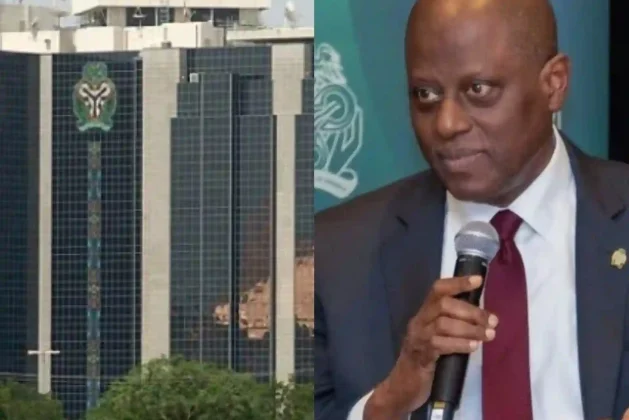
The Central Bank of Nigeria (CBN) just cut the MPR to 23%..
Your Loan, Savings & Investments may all feel it.
Most Nigerians will see this news and scroll past it.
Some people will say,
“Another CBN announcement.”
Others will say,
“23%… wetin concern me?”
But wait.
This one concerns your money.
Whether you are a trader in Onitsha…
A tailor in Aba…
A farmer in Ebonyi…
A businessman in Lagos…
A civil servant in Abuja…
A student trying to start a small business…
Or Mama Ngozi selling tomatoes in the village…
You need to understand what just happened.
Because the CBN has just moved Nigeria’s Monetary Policy Rate from 26.5% to 23%.
That is a 3.5 percentage-point reduction, or 350 basis points.
And before you scroll away because you think this is another financial grammar…
Let me explain what it means in the simplest way possible.
Imagine Mama Ngozi wants to borrow ₦500,000 to expand her tomato business.
She wants to buy more tomatoes during harvest season.
Store them.
And sell them later when prices increase.
She goes to the bank.
Before now, the general interest-rate environment was tighter.
Now the CBN has reduced its benchmark rate from 26.5% to 23%.
Mama Ngozi may hear the news and think:
“Ah! So my bank loan should immediately become 23%?”
No.
This is where many Nigerians misunderstand the news.
The MPR is NOT the interest rate you automatically pay on your bank loan.
It is the CBN’s benchmark policy rate.
Think of it as a signal sent through the financial system.
When the CBN changes this rate, it can influence the rates at which money moves through the banking system.
And over time, that can affect things like:
Loans.
Savings.
Fixed-income investments.
Money-market investments.
Business expansion.
And even economic activity.
But the effect is not necessarily immediate or equal for everybody.
So why did the CBN reduce it?
This is where it gets interesting.
Nigeria’s headline inflation rate was reported at 15.39% in August 2026, according to the National Bureau of Statistics.
That is significantly lower than the inflation rates Nigerians were dealing with during the worst part of the recent inflationary period.
But don’t celebrate too quickly.
Because food inflation is still 19.57%.
So while the overall inflation picture has improved, the cost of food is still putting pressure on Nigerian households.
This is one reason why monetary policy is complicated.
Because…
The CBN has to consider inflation…
Economic growth…
Credit…
Liquidity…
And how effectively its decisions are transmitted to the wider economy.
So this isn’t simply:
“CBN reduced interest rate, therefore everything is now cheap.”
No.
There is a lot more happening behind the scene.
Now let’s talk about YOU.
Yes.
Because this is the part I really want you to understand.
When CBN changes the MPR…
Don’t only ask:
“Will my loan become cheaper?”
Ask:
“What happens to my money?”
That question is extremely important.
As a Financial Literacy Advocate on Fokona, here are the things I want you to know about the MPR.
1. IF YOU WANT TO BORROW MONEY
A lower MPR can create an environment where borrowing costs may eventually come down.
But don’t walk into your bank tomorrow and demand:
“CBN said 23%, so give me a loan at 23%.”
It doesn’t work that way.
Your bank will still considers things like your creditworthiness, the type of loan, its own funding costs, risk, operating costs and other factors.
So the MPR falling does not automatically mean your personal loan rate falls by 3.5 percentage points.
Understand that.
2. IF YOU RUN A BUSINESS
This is where things can become very interesting.
Imagine you run a bakery.
You need ₦5 million to buy a new oven.
Or you run a supermarket and need money to increase your inventory.
Or you operate a manufacturing business and need financing for equipment.
If the broader cost of credit eventually becomes cheaper, businesses may find it easier to finance expansion.
But again…
Eventually.
The CBN cutting the MPR does not mean every Nigerian business will suddenly receive cheap money tomorrow morning.
The transmission from monetary policy to actual lending rates can take time.
3. IF YOU SAVE MONEY
Now let’s talk about the part many people don’t think about.
Lower interest rates can also affect savers.
Yes.
Because…If the general interest-rate environment falls, the returns available on some interest-bearing savings and fixed-income products may also come under pressure over time.
This is why you shouldn’t simply hear:
“Interest rate has fallen.”
and celebrate.
You need to ask:
“What happens to the return on the money I have invested in Money Market Mutual Fund?”
Because the same economic environment that can potentially make borrowing cheaper can also affect the returns available to savers and investors.
4. IF YOU INVEST
This is where financial literacy becomes extremely important.
Suppose you have money in a money-market mutual fund or another fixed-income investment.
You cannot assume that because you received a particular return last year, you will receive exactly the same return next year.
Interest rates change.
Market conditions change.
Yields change.
And investment returns can change.
That is why I always tell people:
Don’t invest because somebody told you the return is high.
Understand why the return is high.
Understand the risk.
Understand what the investment is actually investing in.
And understand what could happen when interest rates start moving in the opposite direction.
But there is something even bigger happening here.
For years, Nigerians have complained:
“Banks should make loans cheaper.”
Now the monetary environment is beginning to move in that direction.
But here’s the question:
Will cheaper money automatically make Nigerians richer?
No.
And this is where we need to stop confusing access to money with wealth creation.
Because…
If I give you cheap money and you use it to finance a business that loses money…
You are still in trouble.
If you borrow ₦10 million and use it for consumption…
You still have to repay ₦10 million plus interest.
If you invest borrowed money without understanding the risk…
A lower interest rate will not save you from a bad investment decisions..
That’s why you need to checkout Some of our Financial Literacy Course on Fokona to enable you master how to become a better investor.
Because…
Cheap money is not the same thing as smart money.
And there is another side to this.
The CBN also announced that banks existing Cash Reserve Requirements would remain in place, including 45% for Deposit Money Banks and 16% for Merchant Banks. It also adjusted the Standing Facilities Corridor around the new 23% MPR.
Now…
If you are reading this and thinking:
“I don’t understand half of what you just said.”
Good.
Not because you should remain confused.
But because this is exactly why financial education matters.
And that’s what Fokona exit to correct.
You don’t need to become an economist.
You don’t need to become an accountant.
You don’t need to understand every word in a CBN communique.
But you should understand enough to know:
What happens to my money when interest rates change?
What happens to my loan?
What happens to my savings?
What happens to my investments?
What happens to my business?
What happens to the price of things I buy?
Those are the questions that matter.
And this is the mistake many Nigerians make.They hear:
“CBN has cut MPR.”
Then they scroll.
Tomorrow they hear:
“Inflation has fallen.”
They scroll again.
Next week they hear:
“Treasury bill yields have changed.”
They scroll.
Then one day they wake up and say:
“Why is my investment no longer giving me the return I used to get?”
Because the economic environment changed.
And you didn’t notice.
So the next time you see:
CBN MPC
MPR
Inflation
CRR
Interest rates
Treasury bills
Bonds
Money Market Funds
Don’t say:
“This is for economists.”
It is about your money.
The moment you earn money…
Save money…
Borrow money…
Invest money…
Or run a business…
economic decisions become personal.
That is why financial literacy is not just about knowing how to make money.
It is about understanding what is happening to the money you already have.
So…
CBN has moved the MPR from 26.5% to 23%.
But don’t stop at the headline.
Ask yourself:
What does this mean for MY money?
That is the question financially literate people should be asking.
And if you don’t understand something…
Ask questions on Fokona.
Don’t be ashamed to learn.
Because the person who understands how money works has information that the person who simply reacts to headlines does not have.
Financial literacy is no longer optional.
It is becoming a survival skill.
And the more you understand how money works…
the harder it becomes for the economy to surprise you.
I am Iking Ferry,
Founder, Fokona
A Financial Literacy Advocate and Investment Strategist, on a mission to build 10 million financially free Nigerians and Africans through Fokona, one lesson at a time.
If this explanation helped you understand the CBN decision, share it with someone who needs to understand it too.
I am truly grateful for this knowledge. I appreciate your effort sir. Thank you
Now I understand better. Thank you Sir.
Thanks for the breakdown on the impact of the CBN MPR reduction
You are welcome
Please explain more on “save and invest money”